Spinal Cord Injury
with Tetraplegia

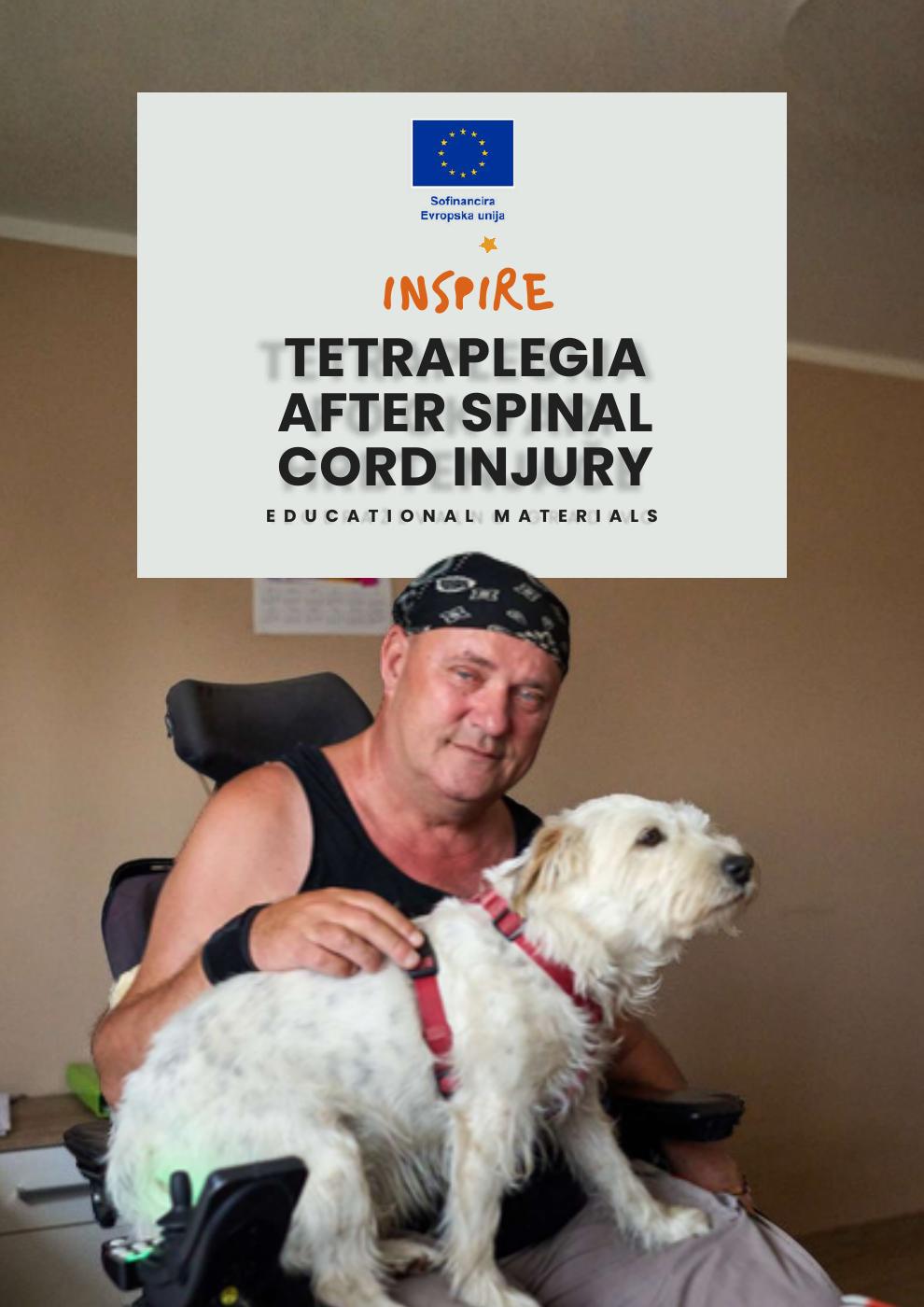
Branko Šenkiš

About spinal cord injury with tetraplegia

Basic information

What actually is the spinal cord?

The spinal cord can be imagined as a cable of nerve fibers that connects the brain to the body below the neck, transmitting instructions from the brain and sending sensory information back. It is a long tube running inside the vertebral column — a bony structure made of vertebrae that protects the spinal cord from injury.

Inside the spinal cord are nerve cells — fibers, or tiny wires, that transmit signals in both directions: from the brain down through the body, and from the body up to the brain:

  • From the brain: signals travel through the spinal cord and nerves to the muscles, instructing them to move.

  • To the brain: signals travel from the body, conveying information about touch, pain, and temperature.

What causes a spinal cord injury?

Spinal cord injuries can result from various causes:

  • Trauma: Most commonly from traffic accidents, falls, sports injuries, or violence (blows, stab wounds, etc.). Vertebrae may dislocate or fracture, damaging the spinal cord within.

  • Inflammatory or disease-related causes: Tumors growing in or near the spinal cord can press on it and damage nerve fibers; infections causing inflammation of the spinal cord can also impair its function.

  • Degenerative changes: Aging and wear of vertebrae, intervertebral discs, and other spinal structures can narrow the spinal canal, compressing and damaging the spinal cord.

How does a spinal cord injury manifest?

  • Complete injury: Nerve connections are entirely severed, stopping all signal transmission below the injury. Signals from the brain cannot reach the body, and sensory signals cannot reach the brain. The person loses all sensation — touch, pain, and temperature — and cannot move limbs below the injury because muscles no longer receive brain commands.

  • Partial injury: Only part of the nerve fibers in the spinal cord are damaged. Some fibers remain intact, so certain signals can still pass. Causes may include injuries that compress only a portion of the spinal cord. Consequences depend on which part is affected: some sensations may be lost (e.g., pain or temperature), while others remain (e.g., touch or vibration). Movement may be weakened but not completely stopped.

What is tetraplegia?

When a spinal cord injury occurs, signal transmission is disrupted below the injury site. If the injury is in the cervical (neck) region, signals between the brain, trunk, and all four limbs (both arms and legs) are impaired. This condition is called tetraplegia — “tetra” from Greek meaning four, and “plegia” meaning paralysis or impaired movement. Tetraplegia literally means paralysis of all four limbs.

Tetraplegia is often accompanied by varying degrees of impaired breathing. The primary muscle for breathing is the diaphragm, and the nerve controlling it originates from the cervical spinal cord. If this part of the spinal cord is damaged, a person may be unable to breathe independently and may require ventilatory support — not because of a lung problem, but because the brain can no longer activate the diaphragm to expand the chest and trigger breathing.

Branko Šenkiš - Balky, CD
Branko Šenkiš, tetraplegija

Branko Šenkiš

musician, former police officer, and quite possibly the proud owner of the most beautiful cacti in the region

After finishing secondary school, Branko worked as a police officer — engaging with people, spending time in the field, sometimes in tense situations, but the work suited him. Clear rules, concrete tasks, responsibility toward others.

Music accompanied him throughout his life. As a child he sang and played, and in his thirties he bought a keyboard and began performing. He has more than twelve hundred performances behind him, and in 2003 he recorded his first CD.

A year later, his life turned upside down. After a traffic accident, he became tetraplegic.

Following rehabilitation, he found himself in a nursing home — not by choice, but because at the time there was no alternative. In 2008, he learned about personal assistance, a service then provided by the organisation YHD. With the help of personal assistants who supported him in everything he could no longer do on his own, he reshaped his life once again. He adapted and renovated his house, began growing cacti, and started living on his own terms again.

Today, he prefers peaceful days: walking his dog, tending to his cacti.

Branko has a gift for saying, very clearly, when something isn’t right — and making sure it gets fixed. Everyone is responsible for their own life, he says.

Want to learn more?

Brochure on tetraplegia

Branko Šenkiš

#RealTalk

“Brez osebne asistence si v tem trenutku življenja ne predstavljam, ker je to način, s katerim zdaj živim sam, brez družinskih članov. Edina možna varianta, ki mi dopušča človeka normalno življenje, se pravi svobodno in brez nekih omejitev.

Kljub temu, da imam 3 odrasle otroke, ki so že vsi pri kruhu, jih ne želim obremenjevati, čeprav se radi oglasijo. Ampak kar se tiče mojih potreb, ne želim nikogar obremenjevati. Vsak ima svoje življenje in želim, da tako tudi naprej ostane.

Dokler je osebna asistenca v takšni obliki kot je, mi to pomeni življenje naprej.”

Branko Šenkiš

Branko Šenkiš

“Če se na vozičku pojaviš v nekem novem okolju, je tako, kot da bi prišel z Marsa. Vsak te gleda, ne ve, kaj predstavljaš, kako se boš peljal, kje se boš peljal, zakaj se boš peljal, kaj delaš tu.

Ampak ljudje, s katerimi sem v kontaktu, recimo, ali pa v tem okolju, kjer se vsak dan srečujemo, pa to jemljejo kot normalno stanje.”

Branko Šenkiš

Branko Šenkiš

“Po prometni nesreči nisem imel druge možnosti in sem se moral nastaniti v domu za ostarele. Ampak človek pri 39 letih ne spada v to okolje, in to je puščalo posledice na psihi. Zato sem iskal rešitve …

Takrat sem naletel na možnost pridobitve osebne asistence.”

Branko Šenkiš

Branko Šenkiš

“V naši družbi je stanje invalida še vedno stigmatizirano. Ljudje nimajo predstave, dokler se s tem ne soočijo.

Človek, ki je bil popolnoma zdrav, pri zdravi pameti, aktiven – če se poškoduje, je to stanje po poškodbi, ne bolezen. Ampak ljudje tega ne ločijo in mislijo, da smo ljudje na vozičku bolni.

Kar ne gre. Gledanje skozi prizmo zdravstvenega stanja je napačno. To je dejansko stanje po poškodbi, ti si kljub temu lahko zdrav.”

Branko Šenkiš

Branko Šenkiš

#INSPIRE

EU logo
The INSPIRE project is carried out under the Erasmus+ programme.

Funded by the European Union. Views and opinions expressed are however those of the author(s) only and do not necessarily reflect those of the European Union or CMEPIUS. Neither the European Union nor the granting authority can be held responsible for them.