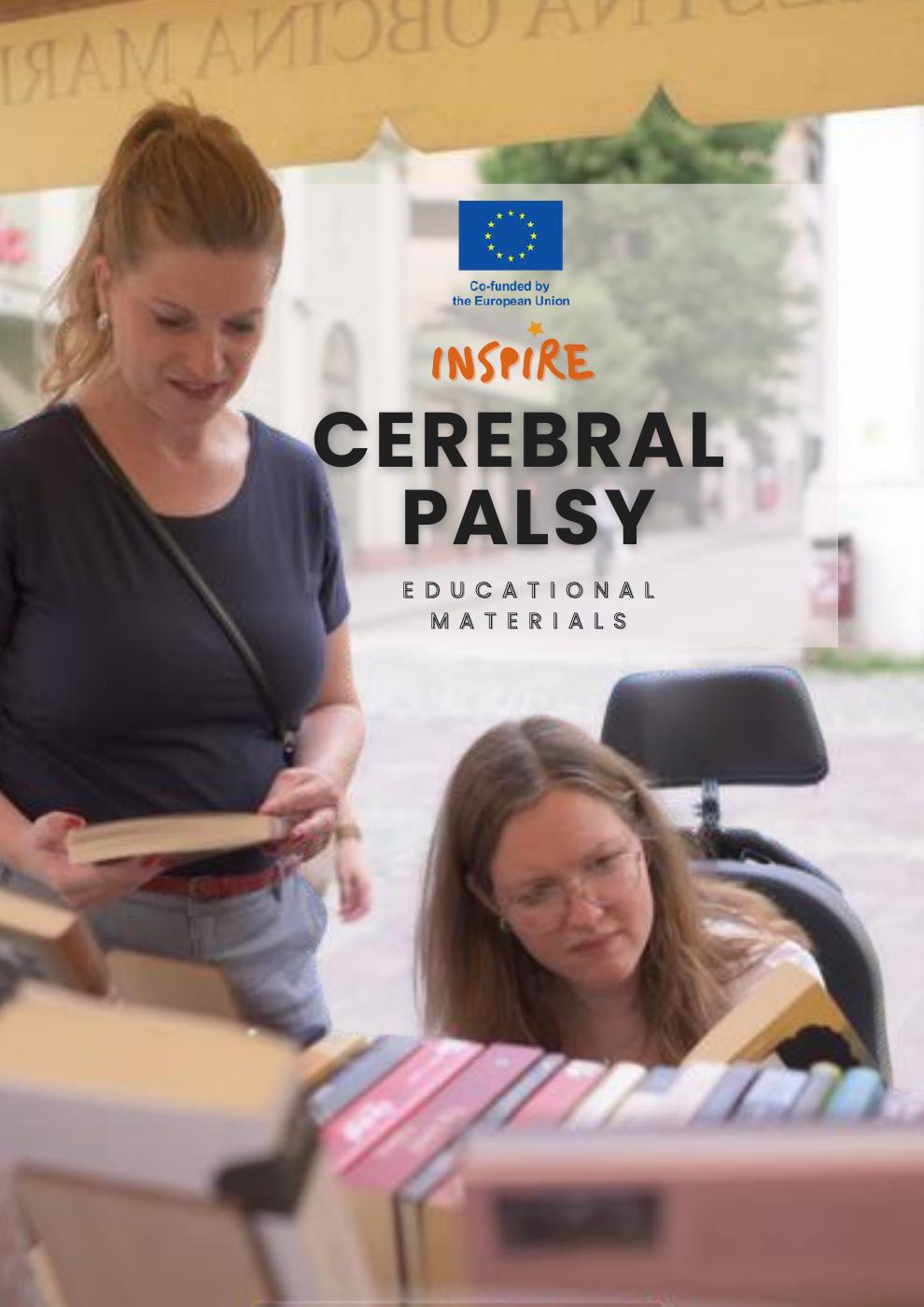
Cerebral Palsy

Agnes Kojc

About cerebral palsy

Basic information

What is it?

The word paralysis refers to difficulties in controlling movement, while cerebral relates to the brain, indicating that the cause of the difficulty lies in the brain, not the muscles.

Cerebral palsy is therefore a condition in which body movements are affected due to damage or abnormal development of certain parts of the brain.

Cause

Cerebral palsy occurs due to damage to the areas of the brain that control movement — but only if the damage happens while the brain is still developing.

Thus it can develop during pregnancy (when the child is still in the womb), during birth, shortly after birth, or in the early years of life, while the brain is still maturing.

How does it manifest?

Doctors and parents may begin to suspect cerebral palsy in a child who is delayed in motor development compared to peers. Signs may include:

  • Difficulty holding the head upright (the head falls back when lifted from lying down)

  • Delays in independent sitting

  • Not opening the hand for a long time

  • Inability to bring objects to the mouth

  • Not rolling over in either direction

  • Crawling abnormally

  • Appearing unusually stiff or floppy compared to other children

Is it progressive?

Cerebral palsy is not a progressive disorder — the brain injury occurs once, very early in development.

However, the effects and symptoms of CP can change over a lifetime.
For example, children may develop joint deformities, muscle contractures, or experience increasing pain due to unusual muscle activity or posture — but this does not mean that the brain injury itself is worsening. These are secondary consequences of living with a movement disorder.

Agnes Kojc

translator, editor, columnist, poet, writer, and advocate for people with disabilities

Agnes is always happy to write — about herself, about metaphors in Poe’s stories, about the silence between the lines of poetry, about the pulse of the Slovene language in translation. She was born in Maribor in 1996, has cerebral palsy, and carries a deep love for stories and language.

She grew up as an only child in Jurovski Dol, surrounded by the unwavering love of her parents and grandparents, who didn’t need to read her bedtime stories for long — by the age of four, Agnes was already reading on her own. She was curious, persistent, a straight-A student — something some people resented, claiming teachers were too lenient with her and that life came too easily. But it didn’t. Not ever. What it did do was move forward.

In 2019, she graduated in English and Slovene, earned a master’s degree on translating Poe’s metaphors, and is now pursuing a PhD. Along the way, she travels, lectures, and takes part in international events as a representative of various organisations — including in Geneva, at the World Health Organization. She also writes, translates, edits, collaborates with magazines, advocates for the rights of people with disabilities, and has been working on a novel for more than a decade. Because truly thoughtful things simply need time.

Agnes hopes to live in Ljubljana one day, but for now, she continues creating where it all began — in Jurovski Dol.

Want to learn more?

Brochure on cerebral palsy

Agnes Kojc

#RealTalk

“V otroštvu na nek način niti nisem čutila, da sem drugačna. Potem se je to malo spremenilo v osnovnošolskem obdobju. Zaradi tega, ker so prišle prve prilagoditve, odločba, in tu pa je potem bilo tisto – v bistvu je sistem povzročil, da sem se začela čutiti drugačno.”

Agnes Kojc

Agnes Kojc

“Z osebno asistenco se je meni odprlo okno v svet. Najboljše pa se mi zdi, da imam nek občutek gotovosti, da bo zdaj poskrbljeno zame v življenju. V smislu, da si bom lahko samostojno organizirala potek življenja in pa tudi kar se tiče potovanj, premikov, na sploh toka življenja.”

Agnes Kojc

Agnes Kojc

“Noben od naše družine, tudi širše družine, se nikoli ni sramoval dejstva, da sem takšna kot sem. Za njih sem vedno bila Agnes. Oni nikoli niso videli vozička, posebnih potreb, samo naš način dela in življenja je tekel temu primerno, da sem ga lahko dohajala.”

Agnes Kojc

Agnes Kojc

“Najbolj napačna predstava se mi zdi, da določeni ljudje mislijo, da ker potrebuješ pomoč, da pa si otrok. Ne, nisi otrok. Odrasla oseba si, odgovorna sama zase. Kar me najbolj moti, so primeri, ko ljudje nagovarjajo moje osebne asistente ali moja starša, ko so poleg mene – mene pa recimo ne.”

Agnes Kojc

Agnes Kojc

“Mi smo lahko vključeni v vse sfere življenja, če so nam dostopne. Z ozkoglednimi pogledi pa se velikokrat zgodi, da nam te sfere določeni ljudje onemogočijo. Ker enostavno nam niti ne dajo priložnosti, da bi lahko pokazali sebe.”

Agnes Kojc

Agnes Kojc

“Eni ljudje mislijo, da invalidi niti nimamo želje po tem, da bi si ustvarili družino, da bi recimo imeli neke partnerske odnose, tudi, da bi bili spolno aktivni. Se mi zdi, da eni še vedno živijo v nekem mehurčku, da smo kot rasa zase, kar sploh nismo. Smo običajni ljudje, kot vsi ostali.”

Agnes Kojc

Agnes Kojc

#INSPIRE

EU logo
The INSPIRE project is carried out under the Erasmus+ programme.

Funded by the European Union. Views and opinions expressed are however those of the author(s) only and do not necessarily reflect those of the European Union or CMEPIUS. Neither the European Union nor the granting authority can be held responsible for them.